ENTRY DESCRIPTION
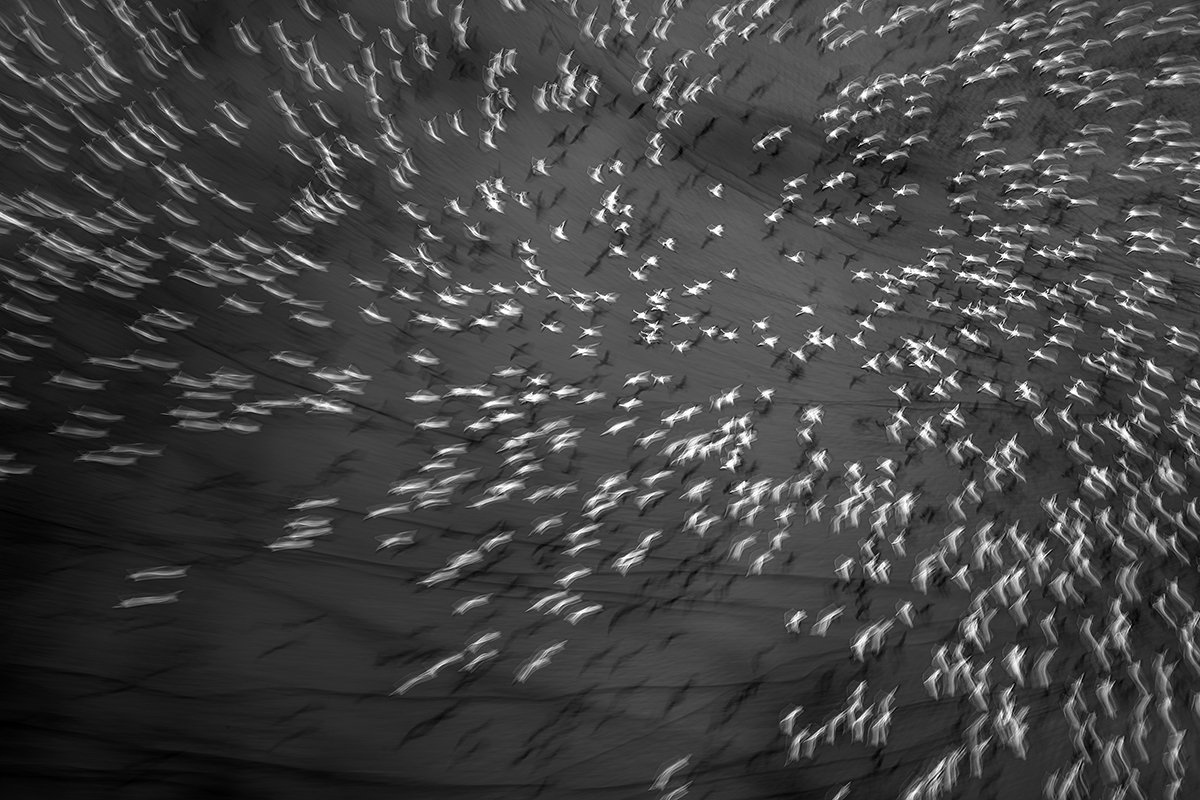
From a helicopter high above Kenya’s Lentorre region, I looked down upon a vast canvas of water and salt. Below me, thousands of flamingos lifted into the air, their synchronized movement painting the landscape in soft shades of pink and blue. It was a living mosaic—rhythmic, fluid, and utterly mesmerizing.
The challenge was immense: the helicopter’s vibration, the unpredictable wind, and the sheer speed of the birds made sharp images nearly impossible. Instead of resisting the chaos, I embraced it. Using a slow shutter speed of 1/10 second, I introduced deliberate motion through exposure-time zooming and subtle camera rotation, transforming the scene into an abstract study of pattern and energy.
Each streak of pink represents not a single bird, but the collective rhythm of the flock—the pulse of life itself. The motion blur softened the details while enhancing the sense of harmony among hundreds of individuals moving as one. The resulting image bridges the boundary between photography and painting, between documentation and emotion.
In that brief flight, the flamingos became brushstrokes on nature’s own canvas, shaped by light, wind, and chance. What began as a technical challenge evolved into an artistic revelation—a reminder that in photography, imperfection often carries the purest form of truth.
AUTHOR
I am a nature and wildlife photographer based in Seattle. My goal in photography is to create images that resemble paintings. While creating an excellent painting can take hours or even years, a photograph can be captured with just one click of the shutter. This is what fascinates and motivates me, and I have been photographing for over 20 years. Recently, I was invited to delve into wildlife photography, which has become even more captivating and inspiring, as it reveals a world where the cycle of life and death unfolds every moment. During this new journey, I discovered that 3S (Slow Shutter Speed) shooting is an incredibly effective tool for making my photos look like paintings—not only because of its painterly appearance but also because each image tells its own story. I believe this effect occurs because The camera's image sensor accumulates photons for 100 to 300 times longer compared to typical high-shutter-speed shooting.
back to gallery